Company History
Fusion Enters a New Phase
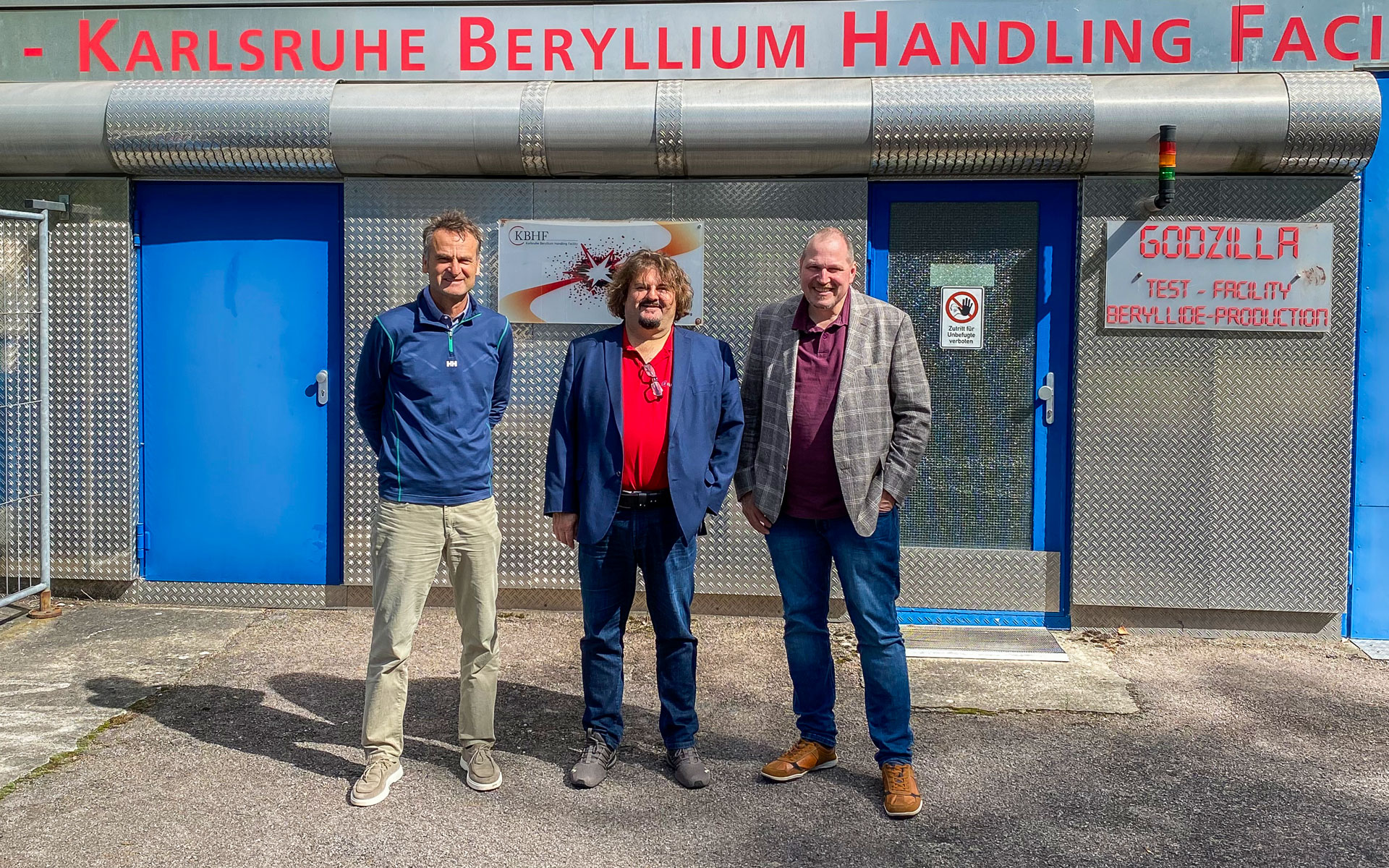
Michel Hübner (ILO), Aniceto Goraieb (KBHF), Daniel Jakob (smolsys CEO)
KBHF laboratory successfully established at KIT – baton to be handed over to the research university within the Helmholtz Association in 2026
The promotion of nuclear fusion in Germany is entering a new phase. Political expectations are already focused on progress in the near future. The Fusion Congress held in Berlin in March 2026 sparked optimism.
The Federal Minister for Research, Technology and Space (BMFTR), Dorothee Bär, is linking her announced nine billion euros from the state’s special fund to milestones on the path to a fusion industry in Germany. By the mid-2040s, it should be possible to commission the first fusion power plant in Germany.
Along the way, the billions are to be used, among other things, to establish three “centres of excellence for laser fusion, magnetic fusion and the fuel cycle, including materials research”, which are expected to deliver the necessary interim successes. However, at the Helmholtz event “Future Forward – Aufbruch 2026” held at the headquarters in Berlin at the end of April, the Federal Minister also indicated that the funds made available would not automatically be spent down to the last euro. Experts in general research funding saw this as a sign that, in future, the release of promised funds could be adjusted in line with the actual progress made. At the same time, however, Bär stated that a possible adjustment was not a reason to perceive this as a “failure”, but rather a necessary measure in view of the realities of the framework conditions. It recently became clear that the BMFTR is expected to save almost one billion euros by 2030.
Fusion hubs – bridges to industry
These fusion hubs, comparable to strategic knowledge networks, also build bridges between research and industry, as well as with small and medium-sized enterprises in Germany. This appears necessary, according to the political consensus, to ensure that scientific and technical findings are continuously translated into practice. The BMFTR’s objective is to ensure “the future of fusion and the expansion of Germany’s leading position, the integration of research and industry, the recruitment of skilled personnel, and finally the regulations and standards for fusion”.
On a somewhat smaller scale, but well-suited to the new phase of fusion funding in Germany, KBHF GmbH – the Karlsruhe Beryllium Handling Facility – is breaking new ground: The Laboratory for Beryllium Alloys, which it established in 2009 based on a public-private partnership and completed just over three years ago, was recently handed over to the Karlsruhe Institute of Technology (KIT). The laboratory is active in at least one field covered by the new centres of excellence, namely the “fuel cycle including materials research”.
Stakeholders in fusion research
To further develop this “energy source modelled on the sun” on Earth, numerous stakeholders of varying sizes must be brought together. The findings from KBHF’s work are useful for addressing questions relating to the drive (fuel for fusion power plants) in both technological approaches: both laser-driven and magnet-driven fusion reactions. Larger laboratories and higher education institutions, as well as companies specialising in the relevant technology – including start-ups such as Marvel Fusion and Proxima in Munich, Gauss Fusion in Hanau, and Focused Energy in Darmstadt – can also benefit from this specialist input.
The ‘passing of the baton’ also fits in with the German government’s vision for a second reason. It aims to utilise resources in research, development and technology even more sustainably in future than has been the case to date. This includes the reuse of infrastructure. The history of the KBHF laboratory’s construction and its operation on KIT’s North Campus is therefore exemplary for science and research management. Old has become new.
Sensible reuse
The former bunker of the former Nuclear Research Centre, later the Karlsruhe Research Centre (FZK: 1956 to 2009), was converted into the heart of the KBHF. For decades, the FZK carried out the training of nuclear engineers and research into fission processes for nuclear power in Germany at its Karlsruhe site. The bunker, secured by thick concrete walls, was required as a control room for this purpose. In the former test hall, a subcritical nuclear test facility called SUAK (Schnelle Unterkritische-Anordnung Karlsruhe) was operated, followed by SNEAK (Schnelle Nullenergie-Anordnung Karlsruhe). This is part of today’s tritium laboratory at KIT.
In addition to the FZK, nuclear research activities in Germany were carried out in Jülich, at the Rossendorf Research Centre in Dresden, at the Hahn-Meitner Institute in Berlin, and at the Munich Research Reactor, amongst other places. However, support for nuclear research policy waned, at the latest, with the Merkel government’s phase-out of nuclear energy. This decision was closely linked to the 2011 tsunami disaster in Japan, at Fukushima. Today, politicians – including members of the Green Party – are pinning their hopes on fusion, which can be regarded as the ‘good form of nuclear energy’.
Spin-in concept for deep tech projects
For over 15 years, the KBHF has established and operated the laboratory for research and development into beryllium on behalf of KIT. Other alloys of extreme materials required for fusion research – which are, among other things, heat-resistant and suitable for neutron production in fusion reactions – have also been tested. “We started by converting the bunker into a ‘second containment’, which was designed with safety in mind in line with the Health and Safety guidelines,” explains the company’s founder and managing director, Aniceto Goraieb, a graduate engineer. The experiments with beryllium could be carried out safely in the bunker. “Negative pressure ensures that even in the event of a malfunction at the glove boxes, no dangerous, volatile substances can escape.” Thanks to the strict safety precautions, no accident has ever occurred in the laboratory anyway.
The KIT’s safety framework has always been crucial here. We have not set up a travel agency or an IT service provider, but a deep-tech company working in close collaboration with the KIT. Goraieb continues: “Anyone who, for the benefit of all involved and in the interests of advancing fusion research, has to work with toxic substances must make complex safety considerations and apply them in practice.” All of KIT’s safety systems also applied to the small company, which defined itself as a “mobile dinghy of a larger research tanker”. “That was a fundamental prerequisite for years of incident-free work and was developed into our approach for the spin-in concept,” explains Goraieb.
Today – recalls the qualified nuclear engineer and graduate of Karlsruhe Institute of Technology – concepts are needed that sensibly break down the lengthy technology transfer process involved in deep tech developments. This also makes economically attractive intermediate steps possible for investors before the distant goal of success can be achieved – a process that, in the case of deep tech, can take over 15 years. Deep tech business models can also represent a path for the economy. This is because these companies are substantially based on scientific and technological business models and, among other things, fit well with the German SME model.
Against this backdrop, Goraieb refers to the spin-in concept, which could serve as an example for collaboration between start-ups and research institutions as well as universities. In contrast to conventional spin-off start-ups, this approach keeps a tech company in “spatial and conceptual proximity to its larger research partner”. The KIT-KBHF model was an example of this. Although KIT never held a shareholding in KBHF under company law, the strategically coordinated and structured direct contract packages from KIT to KBHF offered security, even if this was offset by a narrower scope for action regarding further external third-party funded projects, collaborations with other partners, or even “PR activities surrounding the merger”. “For the small company, however, the cooperation with KIT offered tremendous security, which was also used to establish and expand the laboratory competitively,” said the fusion enthusiast.
Three questions for graduate engineer and nuclear technician Aniceto Goraieb …
What did you not learn whilst studying nuclear engineering at what was then the Technical University of Karlsruhe that you nevertheless need in your day-to-day research and development work?
For me, the political dimension was completely new – something that must be taken into account in research and technological developments. The shift from nuclear research to fusion had to be accompanied by political and communicative efforts – including our own. For a long time, we were in the shadow of ‘evil’ nuclear power. Today, fusion is receiving almost too much positive attention, because fundamental questions still need to be resolved before a power plant can operate. This has to do with representing research policy interests and good communication. I wasn’t familiar with that. That’s why I went on to complete an MBA in Science Management at Osnabrück University of Applied Sciences. The curriculum also included the political and social communication of research topics.
How can deep tech start-ups – that is, companies whose business ideas are based on findings from science, research and technology – benefit from the spin-in concept, particularly in contrast to the more common spin-off model?
We haven’t cut the umbilical cord to KIT. That’s the image of a spin-in. You set up a deep tech company – for instance in cancer, fusion or materials research, wherever there is a high element of risk and infrastructure involved – in close cooperation with the major research partner. It doesn’t work on its own. One accepts the inevitably resulting constraints on freedom of movement. This could be a model for Germany: think of medium-sized companies that, for example, set up a deep tech start-up on or near a university or research campus; they benefit from the flow of knowledge and the academic graduates. Both partners commit to each other for years and achieve success together. Based on our experience, the concept now needs to be tested extensively in Germany up to 2030 and then scaled up. This will enable better transfer of results from science to industry – of that I am certain.
What are you doing now following the KIT collaboration – will you remain in the world of fusion research and development?
I see that – having ‘mission accomplished’ (laboratory set-up) – our company has run its course. We have closed our doors. It is also understandable that our previous work no longer fits into KIT’s current research strategy. ‘Beryllium and more’ is no longer part of the primary remit in Karlsruhe. That is the nature of research; it must be accepted. Research topics simply change. We are now building an international consultancy with a team from Karlsruhe that bridges the gap between fusion and SMEs. The results achieved can be applied to other deep tech topics. Our message ‘Fusion for Future’ naturally remains valid.